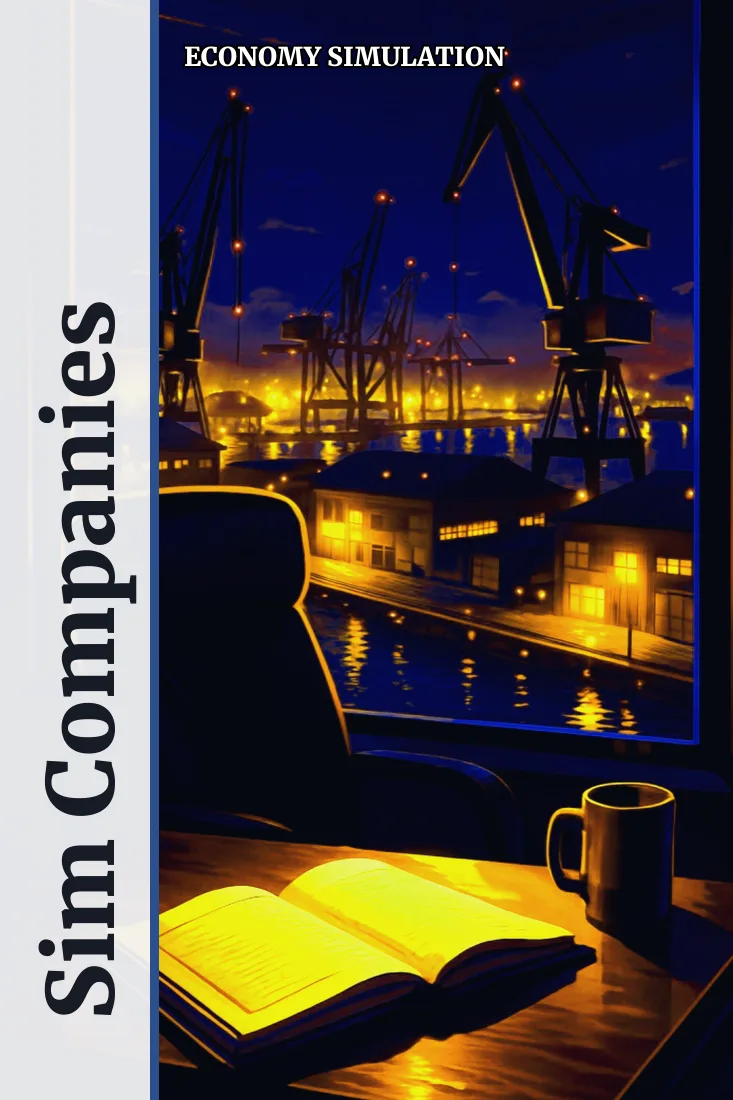
Sim Companies opens quietly. There is no cinematic, no rival chief executive sneering at you, just a modest sum of starting cash, a plot of land and the suggestion that you build something. The first building is cheap, the first product is simple, and within an hour you realize the game is less about what you make than about who wants to buy it and at what price. That shift in focus is the whole game, and it arrives early.
The company behind it, Sim Companies s.r.o., describes it as a strategy game about running a business on real economic principles, and that is a fair summary. Factories, farms, stores, research centres and logistics are the building blocks. Agriculture, energy, fashion, automotive, aerospace and restaurants are among the industries you can work toward. None of it moves without other players, because the exchange where goods change hands has no computer-controlled seller propping up prices.
Why a five-hour production run is a feature
The defining choice here is pace. Production takes real time, often hours, which means you cannot grind your way to a fortune in one sitting. You queue an order, leave, and come back to a finished batch and a market that has moved while you were away. For anyone with a job, a family or a long commute on the GO train, this is a gift. The game asks for attention in short, thoughtful bursts rather than a whole evening.
It also changes how you think. Because each batch is slow, a single wrong decision about what to produce hurts for a day, not a minute. You start reading the exchange before committing, checking what similar companies charge, and noticing which goods sit unsold. That patience is what separates a profitable small firm from a busy unprofitable one. The game never spells this out in a pop-up; it teaches it through your own balance sheet.
An exchange where every number has a person behind it
The exchange is the beating heart of Sim Companies. Buyers and sellers list goods, and the price is whatever the cheapest seller is willing to accept. There is no hidden floor. When a new product unlocks or a popular input runs short, you can watch the price climb in real time and then fall as other founders pile in. Learning to read those waves, and to avoid being the last one in, is the core skill.
Direct contracts are the second, quieter market. Trading straight with another company avoids the exchange fee and is cheaper on transport, so regular partners naturally form. Long-term suppliers become as valuable as any building you own. This is where the game shows its social side: a well-kept partnership with a company two time zones away can steady your whole business through a rough week on the exchange.
Quality, research and the climb up the chain
Early on you sell simple goods, often raw or lightly processed. Research centres let you raise the quality of what you produce, and higher-quality goods open better margins and new buyers. Climbing the quality ladder is slow and expensive, and that is deliberate: it gives established firms a reason to specialize and leaves room for newcomers to compete at lower tiers without being crushed.
As the company grows, the decisions become structural. Do you integrate vertically, producing your own inputs so you are never at the mercy of the exchange? Or do you specialize in one profitable step and buy everything else? Neither answer is always right, and the market shifts often enough that a choice that worked in spring may need revisiting by autumn. That is exactly the kind of long-running question this genre should pose.
Two realms, two ways to begin
Sim Companies runs more than one realm, each a separate economy with its own players and prices. The Magnates realm is the original game with every industry available from the start. The Entrepreneurs realm sets a different starting situation for those who want a fresh field. You can run a company in each, which turns out to be a superb way to learn: mistakes in one realm become lessons in the other.
Retail is the end of the line, and it ties the whole economy to its final customers. Stores sell to simulated shoppers, and how well they do depends on your prices, the goods on your shelves and the competition. It gives the market a natural floor of demand, so even a player-made economy has somewhere for finished products to go. A store that sells steadily becomes the anchor your production plans around.
Your first five business days in Sim Companies
- Build one cheap production building and make a single basic good, rather than spreading your starting cash across three ideas at once.
- Spend ten minutes on the exchange before every production decision, noting what similar goods are selling for and how much is already listed.
- Open a small retail outlet early so finished products always have somewhere to go when the exchange price dips below your costs.
- Look for one regular contract partner, ideally a company that needs exactly what you produce and can supply something you would otherwise buy.
- Write down your cash at the end of each day. A simple running note teaches more than any tutorial about what is actually earning.
What costs us patience
- Early prices can be flooded by established firms, which is discouraging in the first days.
- Higher quality tiers take a long time and plenty of capital to reach.
- Some menus bury useful numbers several clicks deep for no obvious reason.
What earns its keep
- A genuinely player-made exchange where prices move for reasons you can work out.
- Slow production that fits neatly around a working day without punishing absence.
- Contracts between companies that turn rivals into long-term business partners.
- Separate realms that let you test a second strategy without risking the first.
The founder Sim Companies was built for
Sim Companies suits founders who enjoy reading a market and making one careful decision rather than ten hasty ones. If you like the idea of checking in over morning coffee, adjusting a price at lunch and planning expansion over the weekend, it fits your life better than anything else here.
Closing the books on Sim Companies
This is the most complete, most convincing economy on our shelf, and it achieves that without demanding your evenings. The pace is a feature, the exchange feels alive, and the long climb up the quality ladder gives you something to work toward for months. Its early days can feel crowded, but stick with a narrow plan and the game opens up beautifully. It is the first company we would tell anyone to found.