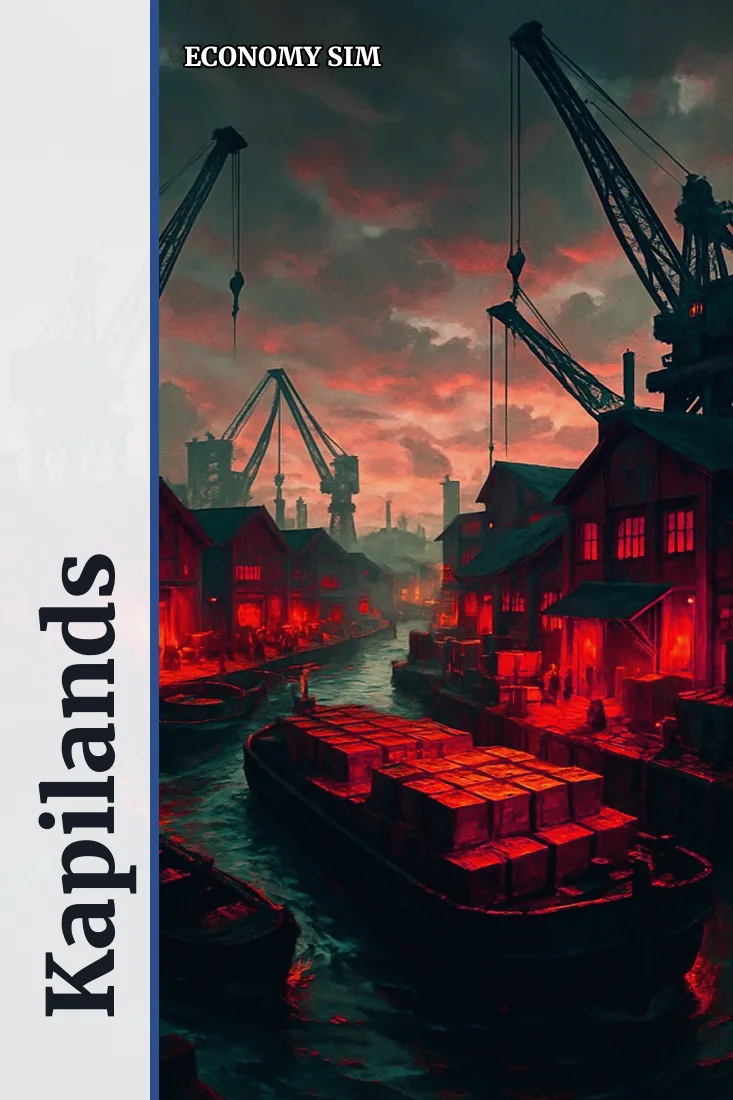
Kapilands is one of the long-standing names in browser economy games, and it feels like a town that has been trading for years. You arrive as a small entrepreneur with a little capital, choose what to produce and start buying raw materials to turn into goods. Livestock farming, agriculture, electrical goods and fashion are among the directions on offer, with more than forty production facilities and up to a hundred products to work toward.
Unlike the slower games on our shelf, Kapilands invites you to tinker. Production runs, quality settings and prices all reward regular attention, and there is always another small improvement to make. The integrated chat keeps the community visible, which makes it feel more like a busy market square than a quiet ledger. It is approachable, sociable and deeper than its friendly look suggests.
Forty-odd facilities and a hundred things to make
The production side is broad. Each facility makes particular goods, and many goods need inputs from other facilities. Early on you will buy most of your materials; later you may produce them yourself to protect your margins. Working out which chain suits your capital and your patience is the first real decision, and it is a satisfying one to make well.
Quality is the second lever. Kapilands lets you determine the quality of your goods, and that choice affects who buys them and at what price. Better quality usually costs more to produce, so you are always weighing the market’s appetite against your costs. It is a simple idea that keeps paying off, because the right answer differs from product to product.
Haggling in a market that answers back
The market follows supply and demand, and it is shaped by other players. When too many firms crowd into one product, prices fall; when something runs short, sellers can ask more. Adapting your strategy to those conditions is how you stay profitable, and the game says plainly that flexibility is the key. Selling locally or exporting are both options when the domestic price disappoints.
Haggling and contracts make the market personal. You can offer goods for sale to other players, negotiate directly and agree strategic contracts that secure supplies for your own expansion. The chat is where much of this happens, and a reputation for fair dealing travels. It is a more conversational market than the anonymous exchanges in Sim Companies or Prosperous Universe.
Antiques, wine and other unlikely fortunes
One of the pleasures of Kapilands is that there is no single road to success. Upjers points to paths such as fixed capital, antiques or wine trading, and players do build very different companies. Some focus on heavy production, some on trading, and some on niche goods that larger firms overlook. That variety keeps the game from feeling like a solved puzzle.
It also makes the game good for long stretches. When one strategy plateaus, another opens up, and a company that has been a steady producer for months can reinvent itself as a trader. Climbing from small entrepreneur to market leader takes time, but the route is yours to choose, which is the kind of freedom long-running economy games should offer.
Where the friendly surface hides some friction
Kapilands is a browser game first and only; there is no app, and it is best played at a desktop with room to see your facilities and the market side by side. The interface shows its age in places, with some screens more cluttered than they need to be. New founders may need a session or two to feel at home, and the help pages are worth reading early.
The pace can also nudge you toward checking in more than you meant to. Production that rewards attention is fun, but on a busy week the game’s appetite for small adjustments can feel like a chore. We found it worked best with a simple routine: two or three short visits a day, a bigger planning session at the weekend, and no guilt about quieter days.
Your first five business days in Kapilands
- Pick one production direction and stick with it for the week, rather than building several unrelated facilities with your starting capital.
- Check the market price of every good you plan to make before you start a production run, and again before you sell.
- Experiment with quality on one product to see how much the market rewards it compared with the extra cost of making it.
- Say hello in the integrated chat. Experienced players often share trading tips and may become your first contract partners.
- Keep a little capital in reserve so a sudden price drop does not leave you unable to buy materials for the next run.
What costs us patience
- Some screens feel cluttered and dated compared with newer economy sims.
- The appetite for frequent small tweaks can turn into a chore on busy weeks.
- No app at all, so it really wants a desktop session.
What earns its keep
- A wide spread of facilities and products leaves plenty of room to specialize.
- Quality settings add a real decision to every product you make.
- Haggling and contracts in chat give the market a friendly, human voice.
- Several different routes to success keep long-term play from going stale.
The founder Kapilands was built for
Kapilands suits the founder who enjoys little and often: a quick production tweak, a chat with a trading partner, a price adjustment before dinner. If you want an economy sim with company and conversation rather than a silent ledger, it is a warm and rewarding home.
Closing the books on Kapilands
Kapilands is broad, sociable and genuinely flexible, with enough facilities, products and strategies to keep a company growing for a very long time. Its interface and its appetite for attention hold it back from the top three, but the market feels lived in and the choices feel your own. For a hands-on founder, it is an easy recommendation.