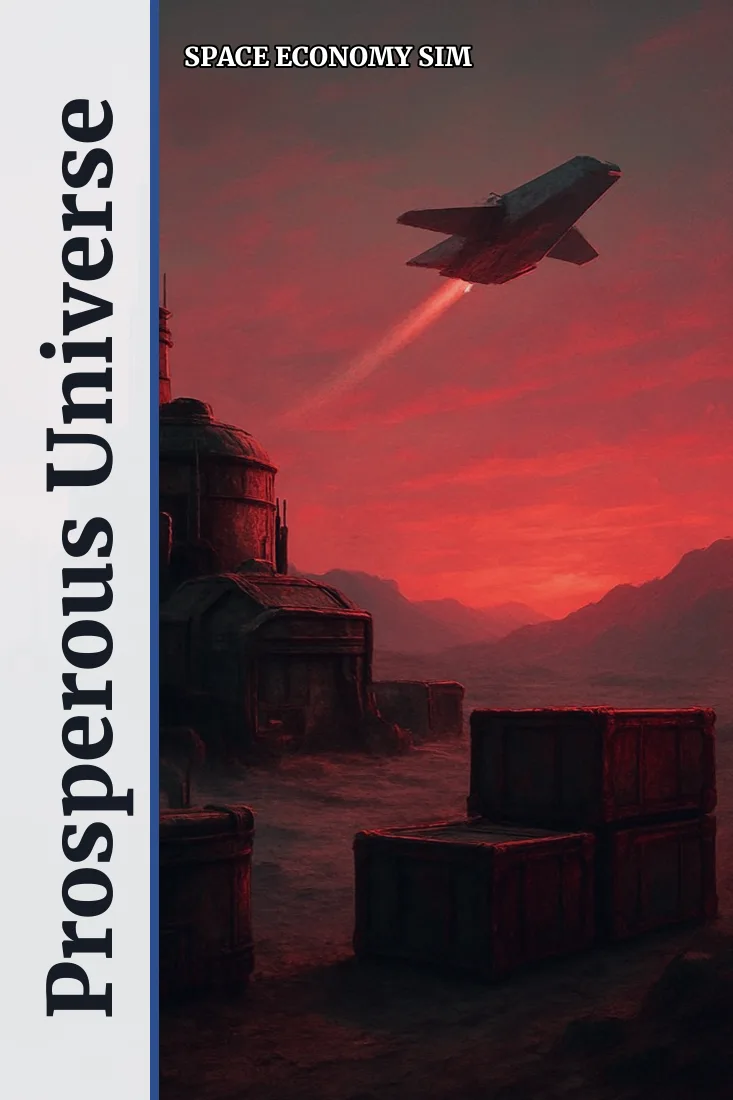
Most space games want you to fight. Prosperous Universe wants you to run a business. There are no lasers to fire and no player-versus-player combat; instead there are thousands of planets, hundreds of star systems and an economy in which every resource and commodity has to be produced by somebody real. If you want building materials for your next base, another player had to mine, refine and ship them. The galaxy is a web of dependencies, and you are one thread in it.
You manage all of this through APEX, a browser interface made of windows you arrange to suit yourself. It looks intimidating on day one, a little like stepping onto a trading floor without a guide. By the end of the first week, most players have a layout they are fiercely attached to. Simulogics describes the game as a browser-based space economy, and that phrase is precise: this is an economy first, and the space part is the map it lives on.
Choosing a planet is choosing a business plan
Founding a base means picking a planet, and planets differ in ways that matter. Atmosphere, temperature, pressure, available minerals, water access and terrain all affect what you can build and how expensive it is to keep running. A rocky world rich in ore suits extraction; a gentler planet near busy trade routes may suit manufacturing. There is no right answer, only trade-offs you will live with for months.
That decision shapes everything that follows. Your workforce lives on the base, and keeping workers supplied with consumables is a constant small duty. A wealthier base supports a larger population, which supports more production. It is a loop that feels very much like running a remote mining town, and it gives each company a real sense of place that pure spreadsheet games lack.
Cargo ships, fuel and the cost of distance
Goods do not teleport. You load ships, plan flights and pay for the fuel to move between planets and systems. Distance has a real cost, which means local supply chains are cheaper and remote markets reward those willing to haul. Many players build a business around logistics alone, running cargo for others under contract, and it is a legitimate path to wealth.
Contracts tie the whole galaxy together. You can agree to deliver goods, buy a shipment or provide transport, and a reputation for reliable delivery opens doors. Commodity exchanges run around the clock, every day of the year, and their prices come purely from supply and demand. Watching a price move because a large producer went quiet over a holiday weekend is one of the strangest and most absorbing things this genre can offer.
Governors, factions and politics without guns
Prosperous Universe has a political layer that grows out of the economy rather than sitting beside it. Planets can have governors, elected by the players who live and work there, and they shape local conditions. Factions with their own interests hold sway over regions of space, and players choose whether to align with them or work against them. All of it is negotiated rather than fought over.
This is where the game’s depth becomes almost overwhelming. Planetary projects need contributions, the Chamber of Global Commerce runs programs that players vote on, and corporations form to pool resources. A newcomer can ignore nearly all of it for weeks. But for those who stay, it is the reason the galaxy feels like a society and not just a market.
Where the free licence draws its lines
The game is free to play, and a free company can trade on the official commodity exchanges, design ship blueprints, join an existing corporation and build bases. The limits are real, though. Free players can only have two ships in flight at once, cannot upgrade their headquarters past level five, and do not have access to local markets or currency trading. There is also a BASIC licence, which lets you accept local market ads and custom contracts from others.
The optional PRO licence removes those caps and adds conveniences such as automatic cargo unloading, unlimited recurring production orders and the ability to run for governor or found a corporation. We played free for well over a month and never felt locked out of the core loop, but the ceiling is lower here than in any other game on our shelf. Plan around it rather than being surprised by it.
Your first five business days in Prosperous Universe
- Follow the tutorial fully, even when it feels slow. APEX has more windows than any game here, and the tutorial shows which ones matter.
- Choose your first planet for what it produces cheaply, not for how it looks on the map or how close it sits to the centre.
- Keep your workforce supplied with consumables before chasing profit. Unhappy workers quietly cut production and drain your margins.
- Sell your first surplus on a commodity exchange to learn how orders fill, then compare that price with what nearby players charge.
- Join a corporation or a player community early. Experienced players explain more in an hour than the handbook does in a week.
What costs us patience
- The APEX interface is overwhelming for the first several sessions.
- Free players hit firm limits on ships, headquarters and markets.
- Its depth demands more weekly time than any other game here.
What earns its keep
- Every single commodity comes from a real player, with nothing propping up prices.
- A complete absence of combat makes cooperation and negotiation the real game.
- Planet choice has lasting consequences that give each company its own character.
- Exchanges open every hour of the year, so the economy always has a pulse.
The founder Prosperous Universe was built for
Prosperous Universe is for the founder who opens a spreadsheet for fun. If you want a galaxy where your company truly matters to others, and you are happy to spend the first week learning an interface, nothing else on this site comes close to its depth.
Closing the books on Prosperous Universe
The most ambitious economy on our shelf and the most demanding. Its player-produced galaxy, round-the-clock exchanges and politics without guns make it unique in the browser. The free licence is generous enough to learn the game but noticeably tighter than its rivals, and the time it asks will not suit everyone. For the right player, though, this is the one they will still be running years from now.